

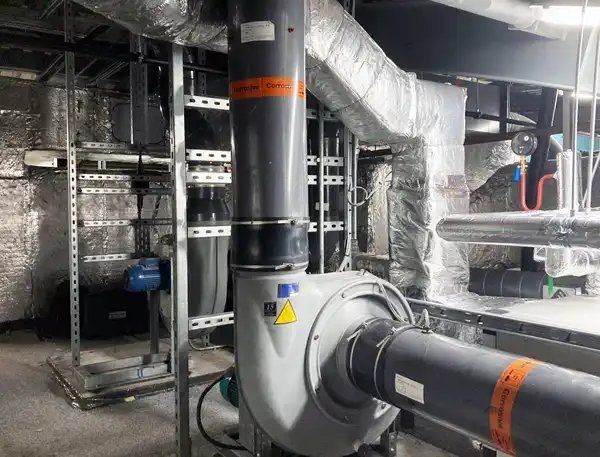
Local Exhaust Ventilation (LEV)
Survey, Remediation & Compliance Case Study
Pharmaceutical Manufacturing | COSHH Regulation 9 Compliance
They had a testing programme in place. They were still non-compliant. This is more common than most organisations realise.
When CAT was engaged by this pharmaceutical manufacturer, they were not an organisation that had ignored their LEV obligations. They had testing activity in place. Records existed. Systems had been examined. But when we looked closer, a critical gap emerged: their fume cupboards had been subject to BS EN 14175 performance testing only - not the COSHH Regulation 9 Thorough Examination and Test (TExT) required under UK law. In the eyes of the HSE, they were non-compliant.
This is the pattern we encounter regularly across Life Sciences, Pharmaceuticals, Defence, Academia, Aerospace, and Manufacturing. It is rarely a story of negligence. It is a story of gaps - in testing scope, in documentation standards, in equipment condition - that go unnoticed until an audit or inspection makes them visible.
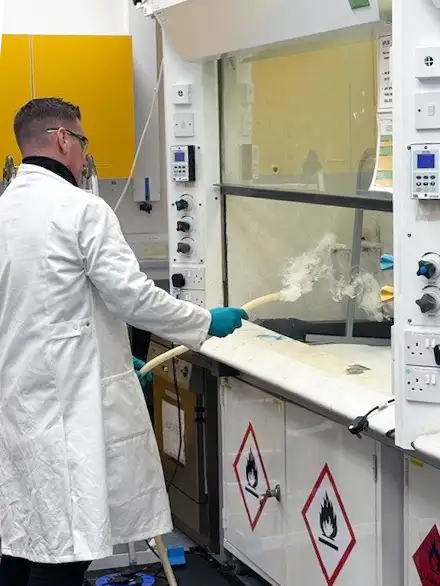
The Client and the Challenge
An established pharmaceutical manufacturer operating multiple LEV systems to control airborne contaminants - dusts, fumes, vapours, and chemical substances - arising from manufacturing processes. LEV performance was the primary engineering control protecting employees from hazardous substance exposure.
The client required an independent review to confirm that their LEV systems were being examined, tested, and documented in accordance with UK statutory requirements. What they discovered was more significant than they anticipated.
What We Found: Five Non-Conformities
CAT conducted a two-phase assessment: a physical on-site inspection of all LEV systems - fume cupboards, capture arms, ductwork, fans, filters, and airflow indicators - combined with a desktop review of existing test reports, records, and calibration certificates. Five priority non-conformities were identified.
| Non-Conformity | Risk & Consequence | Statutory Duty |
|---|---|---|
| Airflow indicators inoperative on 7 fume cupboards | Operators unable to confirm adequate extraction during hazardous substance handling | HSE expectation: airflow indicators used to confirm extraction performance |
| Defective dampers on 2 capture arms | Impaired airflow control; increased risk of inadequate exposure control | COSHH duty: maintain effective control measures for hazardous substances |
| No COSHH Reg 9 TExT evidenced for fume cupboards | Only BS EN 14175 performance testing recorded; statutory TExT absent | COSHH Regulation 9: TExT required at minimum every 14 months |
| TExT reports non-compliant for capture-hood systems | Omissions included schematics, process descriptions, and qualitative test evidence | COSHH ACoP / HSE guidance: minimum content requirements for TExT reports |
| Expired calibration certificates | Measurement validity and traceability not demonstrable for prior testing | HSE expectation: calibrated instruments required for defensible test results |
Taken together, these findings indicated a clear shortfall against the statutory requirement to maintain LEV in an efficient state, in efficient working order and in good repair, and to conduct thorough examination at least every 14 months.
What We Did: A Fully Turnkey Response
At CAT, we don't identify problems and leave clients to resolve them. We issue a corrective action plan, carry out the remediation, complete the statutory testing, and issue fully compliant documentation. The scope agreed with this client covered every identified non-conformity:
- Installation of TEL AFA1000 airflow indicators on seven fume cupboards, reinstating point-of-use airflow confirmation for operators
- Replacement of defective dampers on two capture arms, restoring stable airflow control and capture effectiveness
- Completion of COSHH Regulation 9 TExT for all LEV systems on site, satisfying the statutory examination requirement
- Issue of fully compliant TExT reports including schematics, process descriptions, qualitative test results, and photographic evidence - producing an audit-ready record set
All works were completed by CAT's P601-qualified technicians. We maintain a pool of 20+ competent, on-road specialists experienced across a wide range of LEV device types, including MBSCs, fume cupboards, full enclosures, booths, capture arms, and more. Every technician meets our minimum qualification standard, with many having achieved P602, P603, P604 and W201.
Test. Interpret. Remediate. Retest. We give clients solutions to problems - not just a report identifying them.
The Results
2 Weeks
To initial site visit
8 weeks
To full COSHH compliance
10 Days
To compliant TExT reports
| Compliance Deliverable | Verified Outcome |
|---|---|
| Initial site visit from client request | Within 2 weeks |
| All corrective works and COSHH Reg 9 TExT completed | Within 8 weeks of purchase order |
| Fully compliant TExT reports issued | Within 10 working days of site completion |
| Airflow indication reinstated | 7 fume cupboards - TEL AFA1000 installed |
| Capture-arm airflow control restored | 2 systems - defective dampers replaced |
| Audit-ready documentation produced | Schematics, process detail, qualitative tests, photographs |
The client achieved full COSHH Regulation 9 compliance, with defensible evidence of LEV control effectiveness ready for internal governance, audit, and HSE engagement. The engagement also established a clear baseline for ongoing 14-monthly TExT scheduling - providing the foundation for a sustained compliance position going forward.
Why Organisations Choose CAT
Fully Turnkey
Test, interpret, remediate, retest. We solve the problem, not just name it.
Best-in-Class Technicians
All technicians hold a minimum P601 qualification. 20+ competent specialists on the road nationally.
Regulatory Alignment
All TExT work aligned to COSHH Regulation 9 and HSG258. Documentation built for audit and HSE inspection.
Wide Device Experience
MBSCs, fume cupboards, full enclosures, booths, capture arms and more. Skilled across the full range.
National Coverage
Serving clients across the UK in Life Sciences, Pharmaceuticals, Defence, Academia, Aerospace and Manufacturing.
Speed Without Compromise
Compliance within 8 weeks. Audit-ready reports within 10 working days. Scheduled to minimise operational disruption.
Find Out Where You Stand
If this case study raises questions about your own LEV programme - whether that's your testing coverage, the adequacy of your documentation, or the condition of your equipment - we'd welcome the opportunity for a short, no-obligation conversation.
A number of organisations have already reached out following Jamie Allen's recent presentation with the ISTR, BOHS and HSE. In each case, the starting point is a brief discovery call to understand your current position and identify where CAT can add value.